

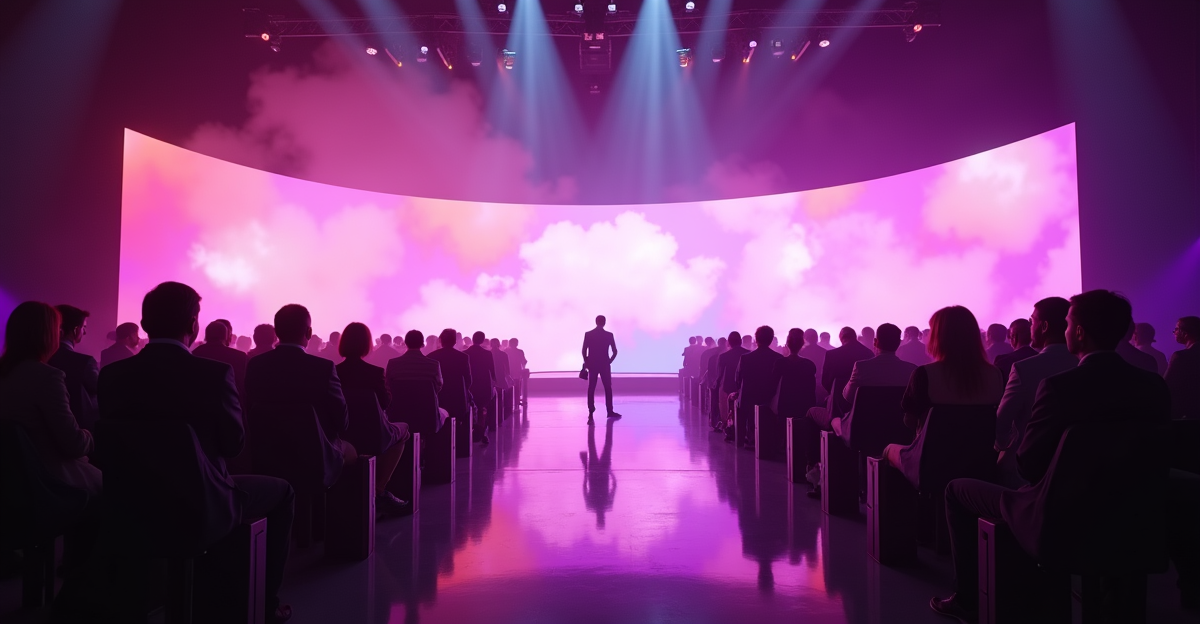
Curved and creative LED video walls free events from the flat rectangle. Walls now wrap audiences. Corners become environments. Floors meet walls seamlessly. LED is modular, so panels build almost any shape. As a result, 2026 stage design leans hard into geometry. However, curves change everything downstream. Content must fit the shape. Cameras must work against it. Budgets must respect the physics. So here is the practical guide.
What Curves Do That Flat Cannot
First, immersion. A curve fills peripheral vision, which is why wraps film so powerfully. Second, sightline equality. Side seats see content instead of a foreshortened smear. Third, environment-building. Paired with designed content, a curve reads as place rather than screen. In short, it is the affordable cousin of the XR volumes it resembles.
Design Content for the Shape
A 16:9 video stretched across a twelve-metre curve looks exactly as wrong as it sounds. Instead, creative walls need content built to the pixel map. That means motion designed across the geometry, plus calm zones behind speakers. Busy content behind a presenter ruins IMAG and the stream. So budget content design beside the hardware. Teams forget it routinely. Then they regret it.
Filming Against LED: The Craft
Camera and wall must agree. First, match shutter and refresh to kill flicker. Next, manage moiré through distance and focal choice. Then balance exposure, so presenters are not silhouettes against a 5,000-nit sunset. Also key-light the people and trim the wall to camera. In practice, that calibration happens at rehearsal, per our AV and video seam guide.
What Drives an LED Build
Four things move the specification. First, pixel pitch, which follows viewing distance rather than brochure maximums. Front rows at three metres need a finer pitch than an audience sitting five metres back.
Second, geometry. Curves need curved or narrow panels plus structural support, and both add build time. Third, content design, which teams routinely forget and always regret. Fourth, rigging, since a venue with no certified points pushes everything onto ground support.
So walk the room before specifying anything, using our venue capability checklist. In practice, the room decides the wall.

Frequently Asked Questions
What pixel pitch does a curved wall need?
Front row at three metres: 2.6mm reads clean. At five metres or more, 3.9mm saves real money.
Can existing content run on a curved wall?
It can be remapped and extended. However, native design for the shape always outperforms adaptation.
Do curved walls suit hybrid events?
Beautifully, when content zones are camera-planned. As a result, remote viewers get an environment rather than a backdrop.
Design the Shape, Then the Show
We film against creative LED weekly, and we design coverage with the wall rather than despite it. So talk to us.
